|
AUTOZINE TECHNICAL SCHOOL
Electrohydraulic valve control Example:
FIAT Multiair
Some variable valve control systems, such as BMW Valvetronic, Nissan VVEL and Toyota Valvematic, are capable to vary valve lift infinitely according to needs. In addition to continuous variable cam phasing, they seemed to be very capable already. However, these systems are still far from perfect. An ideal valve control system should allow unlimited flexibility of valve strategy - in other words, any valve lift at any time - to achieve the desired combustion effect. No mechanical systems can ever achieve that function. Therefore some consultants and suppliers are working on fully electromagnetic valvegears. However, until now such technology still faces technical challenges difficult to overcome, such as size / weight, costs, reliability and energy consumption. Instead of that, the powertrain engineers at FIAT group developed a more practical, but still very flexible enough, type of variable valve control mechanism. They call it "Multiair". The first application is to be introduced to the 1.4 FIRE engine in 2009, then follow by a new 900cc twin-cylinder engine. Unquestionably, Multiair is the most flexible kind of VVT system until now. From the graphs below you can see it enables at least 5 different types of intake valve strategies to suit different running conditions. Apart from the usual transition between long duration and short duration, high lift and low lift, it also allows late valve opening, early valve closing and, wow, multiple valve lifts during an intake stroke ! Now let us see its mechanism. The Multiair system initially works with SOHC 4-valve construction because its additional electrohydraulic components occupy the space originally left for intake camshaft. While the single camshaft operates the exhaust valves directly in conventional way, it operates intake valves via a series of components: roller rockers ----> hydraulic pistons ---> hydraulic chambers (which incorporate electronic-controlled solenoid valves) ---> hydraulic valve actuators. This mean the actuation is implemented by a combination of mechanical and hydraulic means. Normally, when the solenoid valve is de-energised and closed, the oil cannot enter the hydraulic chamber, thus it flows directly from hydraulic piston to valve actuator. You can see this hydraulic link as a solid body because the oil has no where to escape. Therefore the intake valve movement follows exactly the intake cam lobe profile. As the intake cam profile is designed to favour high power (i.e. high lift and long opening duration), this strategy is suitable for high rev running. (Fig 1) 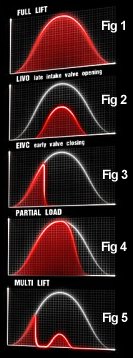 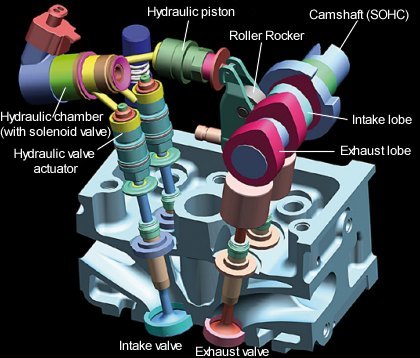 When the solenoid valve is energized, it opens and allows the oil to flow into the hydraulic chamber. As a result, no oil will flow to the valve actuator, thus the intake valve will close under the force of its rebound spring. In this way, Multiair can shut down the intake valves at any desired instant. (Fig 3 and Fig 4) Suppose the intake valve has closed for a while, then the solenoid valve of hydraulic chamber is closed again. What will happen ? In this case, oil will flow directly to valve actuator again, thus the intake valve will follow the cam profile and open again. However, as some time and oil volume has already "lost" (at the hydraulic chamber) during the solenoid valve opening, the valve lift will be reduced. The degree of reduction depends on the instant of solenoid valve closure. The later the solenoid valve close, the lower valve lift will be obtained. In this way, Multiair can vary the lift and opening duration of intake valves. (Fig 2) Now let us see the above valve lift graphs again: Fig 1 is suitable for high rpm running. Fig 2 is sutiable for low-load operation. Its late valve opening leads to a partial vacuum in the combustion chamber. In addition to the low valve lift, the intake air stream is greatly speeded up, generating turbulence thus improve air and fuel mixture. This benefits fuel economy and emission. Fig 3 is suitable for a wide range of part-load operation. Depending on the requirement of power, the amount of air can be controlled by the early closing of intake valves. This eliminates the need of throttle butterfly (like BMW Valvetronic) and reduce pumping loss by up to 10%. Fig 4 is designed for enhanced low-rpm acceleration. While it enables more intake air volume compare with Fig 2 & 3, its early valve closure ensures no air flow back into the intake manifolds near the end of the intake stroke. (Remark: the combination of fast cam timing and low rpm operation could lead to backflow, that's why Multiair needs to close the valves earlier. Other engines do not have this issue because they either use variable cam phasing or compromised cam timing) Fig 5 is so-called "Multilift" mode and designed for very low rpm operation. It combines the strategy of Fig 2 & 3 and their benefits - regulated consumption and improved quality of air-fuel mixture. Combining these modes, FIAT claims Multiair improves maximum power by 10%, low-rpm torque by 15% and fuel economy by 10%. Moreover, cold-start emission of HC/CO and NOx are reduced by 40% and 60% respectively due to its ability of exhaust gas recirculation. This technology is also compatitble with diesel engines, which means substantial cost reduction. However, I can see a few weaknesses of Multiair: Firstly, at the moment it is compatible with SOHC engines only because of the bulky mechanism. This mean while it enables variable timing and lift for intake valves, it offers neither for exhaust valves. The addition of variable exhaust cam phasing may require a complex cam-in-cam mechanism like that used by Dodge Viper 8.4. Secondly, the SOHC design and the complicated electrohydraulic mechanism could generate extra friction, thus it is not suitable to high-revving high performance engines, which is a common problem shared with BMW Valvetronic. It is more suitable to mass production engines and low-revving turbocharged engines. Lastly, the electrohydraulic mechanism might complicate servicing and raise reliability issues.
|
||||||||
| Copyright© 1997-2011 by Mark Wan @ AutoZine |