|
AUTOZINE TECHNICAL SCHOOL
Rover's unique VVC system British car maker Rover introduced its own
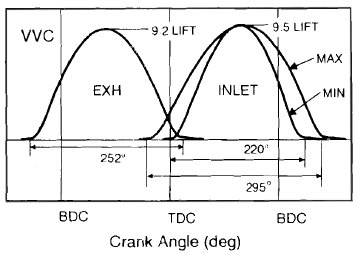
VVT system called VVC (Variable Valve Control) on MGF in 1995. Many
experts regarded it as the best VVT system at the time. The VVC can
continuously vary the duration of intake valve opening from a minimum
220 degree (crank angle) to a maximum 295 degree. This is unlike
cam-phasing VVT systems, which can only shift the point of valve
opening forward or backward but have nothing to do with the duration of
opening. As a result, the VVC enables higher flow into the combustion
chambers at high rev, benefiting high-end power output. On the other
hand, unlike cam-changing systems, its adjustment of valve opening
duration is continuous, thus mid-range torque is optimized. This make
it a better compromise between power and flexiblity than either
systems. The following diagram shows its valve timing:
 To realize this continuous variation of valve opening duration is a big technical challenge. At high rev, the duration of intake valve opening shall be lengthened, while the duration of intake valve closing shall be shortened. Therefore, the intake camshaft has to rev slower just when the cam lobe is acting on the intake valve. Once the valve is closed, the camshaft has to speed up to shorten the valve closing duration. In the next cycle, the camshaft has to slow down again when the intake valves open, so forth. How to realize such a non-constant, pulsation-like camshaft rotation speed ? The Rover VVC system uses a very complicated mechanism to implement that. It is difficult to understand, but in essence it utilizes the special property of eccentric drive wheel. Because an eccentric drive wheel rotates about an off-center shaft, if you turn its outer drive ring at constant speed, the shaft will rotate at non-constant, pulsation-like manner. The speed difference depends on the distance between the shaft and the wheel center, i.e. the longer the distance, the larger difference of rotational speed. The VVC uses a slidable shaft to vary this distance hence the speed difference. 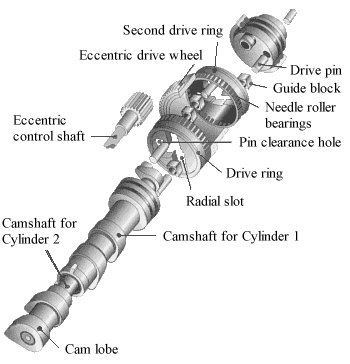 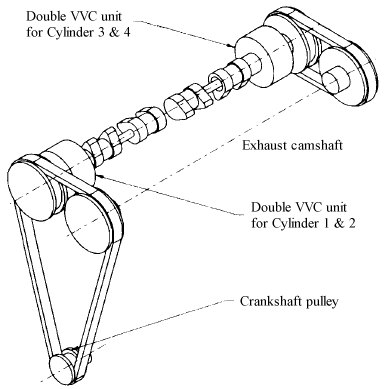 The problem is, a camshaft serves multiple cylinders, which have contradicting requirements. For example, cylinder 1 is working at intake stage while other cylinders have their intake valves closed. Suppose the engine is running at high rev, cylinder 1 calls for a slower rotation of intake camshaft while other cylinders need quicker rotation. As a result, the VVC cannot adopt a single intake camshaft like conventional engines. In fact, it needs 4 camshafts for a 4-cylinder engine ! The right hand side picture above shows the 4 camshafts are arranged in 2 groups. Each group has a rigid camshaft (for the inner cylinder) running within a hollow camshaft (for the outer cylinder). Each group is driven by a double-VVC actuator which has 2 drive rings to actuate the 2 camshafts. Because the two groups of camshafts are not connected at all, an additional drive belt has to be introduced. To save space and weight, Rover simply uses the exhaust camshaft to drive the other intake camshaft group. As you can see, the VVC is a very sophisticated kind of engineering. Compare the Rover 1.8 VVC engine with its non-VVC version, its output is lifted from 120 hp to 145 hp, while maximum torque is improved from 122 to 128 lbft. On the down side, its complexity means higher costs. A four-cylinder engine needs 2 VVC actuators. A V6 engine even needs 4 of them. And then there are the more complicated camshafts and drive belts. These disadvantages prevent it from becoming popular. Following the demise of Rover, the VVC also came to the end.
|
||||||||
 |
||||||||
| Copyright© 1997-2011 by Mark Wan @ AutoZine |