|
AUTOZINE TECHNICAL SCHOOL
Cam-phasing VVT Cam-phasing VVT is the simplest, cheapest
and most commonly used mechanism at this moment. However, its
performance gain is also the least, very fair indeed.
Basically, it varies the valve timing by shifting the phase angle of camshafts. For example, at high rev, the inlet camshaft will be rotated in advance by 30° so to enable earlier intake. This movement is controlled by engine management system according to need, and actuated by hydraulic valve gears. 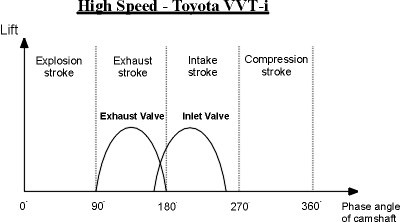 Note that cam-phasing VVT cannot vary the duration of valve opening. It just allows earlier or later valve opening. Earlier opening results in earlier closing, of course. It also cannot vary valve lift, unlike cam-changing VVT. However, cam-phasing VVT is the simplest and cheapest form of VVT because each camshaft needs only one hydraulic phasing actuator, unlike other systems that employ individual mechanism for every cylinder. Continuous or Discrete Simpler cam-phasing VVT systems offer just 2 or 3 fixed phasing angles, such as either 0° or 30°. Better systems can vary phase angle continuously. Obviously, this provides the most suitable valve timing at any rev, thus greatly enhance engine flexiblility. Moreover, the transition is seamless and hardly noticeable, contributing to refinement. Today, continuous systems have put discrete systems in extinction. Intake and Exhaust Some designs, such as BMW's Double-Vanos system, has cam-phasing VVT at both intake and exhaust camshafts. This enables more overlapping, hence higher efficiency. This explain why BMW M3 3.2 (100hp/litre) is more efficient than its predecessor, M3 3.0 (95hp/litre) whose VVT is bounded at the inlet valves. In the E46 3-series, the Double-Vanos shifts the intake and exhaust camshaft within a range of 40° and 25° respectively. 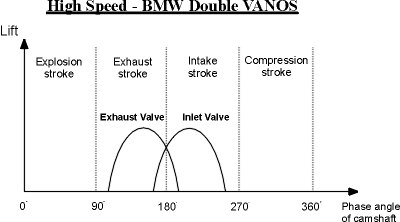
Example: BMW Vanos / Double Vanos 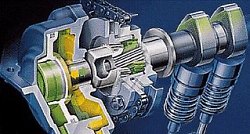 Whether push or pull is determined by the hydraulic pressure. There are 2 chambers right beside the cap and they are filled with liquid (these chambers are colored green and yellow respectively in the picture) A thin piston separates these 2 chambers, the former attaches rigidly to the cap. Liquid enter the chambers via electromagnetic valves which controls the hydraulic pressure acting on each chambers. For instance, if the engine management system signals the valve at the green chamber open, then hydraulic pressure acts on the thin piston and push the latter, accompany with the cap, towards the camshaft, thus shifts the phase angle forward. Continuous variation in timing is easily implemented by positioning the cap at a suitable distance according to engine speed. The Vanos system works at intake camshaft only. However, it can be dupicated at the exhaust camshaft to provide a wider range of adjustment. BMW calls this Double Vanos or Bi-Vanos. Another example: Toyota VVT-i 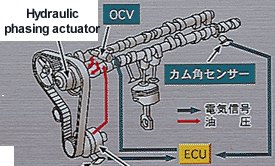 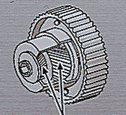 Macro
illustration of
the phasing actuator Macro
illustration of
the phasing actuator Toyota's VVT-i (Variable Valve Timing - Intelligent) has been expanding to more and more Toyota models, from the tiny Yaris (Vitz) to the Supra. Its mechanism is more or less the same as BMW Vanos. It is also a continuously variable design. However, the word "Intelligent" emphasizes the smart control program. Not only varies timing according to engine rev, it also considers other parameters such as acceleration, going up hill or down hill. |
||||||||
 |
||||||||
| Copyright© 1997-2011 by Mark Wan @ AutoZine |